


Skip to content

Planned dehumidifier maintenance

Dehumidifier maintenance

Filters, rotors, fans, heaters and sensors drift if they are left. Newsome maintains industrial dehumidifiers across the UK, for DST and for other manufacturers, including older and mixed sites. The work is planned visits, reports, and callout support when a fault appears between visits.

Engineer in a high-visibility jacket reviewing a plant schematic on a tablet
  • Not only DST

    DST, other manufacturers, custom-built units, and both desiccant and refrigeration systems.

  • A written visit

    Service reports, performance logs and notes on what should be done next.

  • Filters held for the job

    G4 and F7 filters, and other grades used by different manufacturers.

  • Callout as well as the plan

    Breakdowns are handled by the national service desk and engineers from regional hubs.

Ask about maintenance

Tell us the make and model if you have them, how many units, and whether you want a planned programme or a one-off visit. Choose Service or maintain existing equipment. We reply during opening hours.

Or call 01422 312 562

Monday to Friday, 8.30am to 5.00pm

    What regular maintenance is for

    A blocked filter, a tired rotor or a heater that is no longer at temperature changes capacity and energy use. The published reasons for keeping a programme in place are below. They describe the aim of the work, not a result on every site.

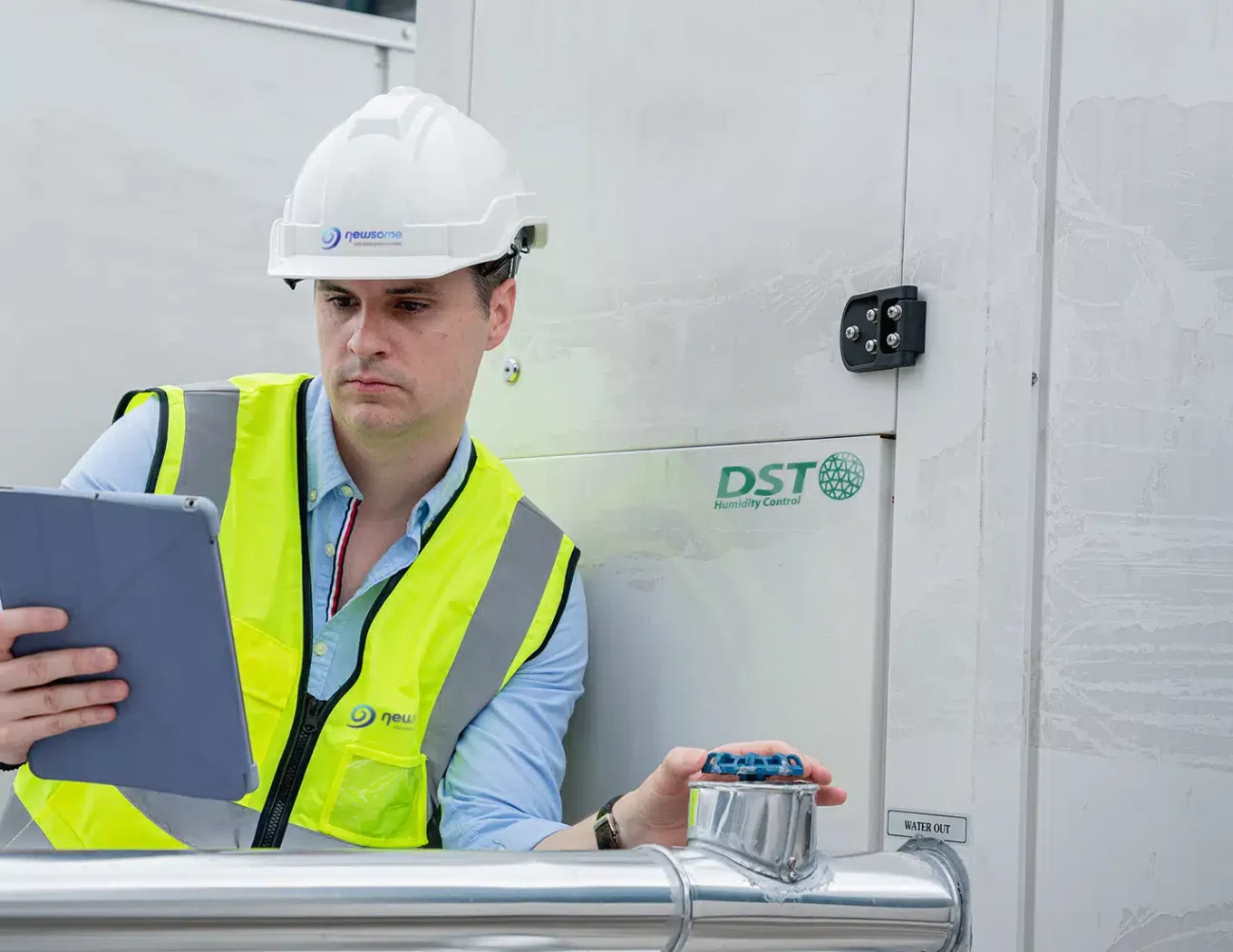
    Newsome engineer with a tablet beside a DST dehumidifier
    • Efficiency and energy use

      Clean airflow paths and working heaters are how the unit stays on its intended duty.

    • A stable humidity result

      Sensors and controls are checked so the unit still responds to the condition in the space.

    • Fewer unplanned stops

      Wear is picked up on a visit instead of as a breakdown during production.

    • Equipment kept in service

      Components are cleaned, adjusted or replaced while the unit is still the right one for the job.

    What a maintenance visit includes

    The list below is the published maintenance service. A planned programme sets how often each item is done, from the size of the system, the hours it runs and the conditions around it.

    1. Routine inspection

      Airflow, filters, rotor condition, reactivation heaters, belts, motors and fans, seals, ducting and insulation, signs of water ingress, and sensor performance.

    2. Filters

      Inspected, cleaned or replaced. G4 and F7 filters can be supplied, along with other grades the manufacturer specifies.

    3. Rotor

      Rotation, speed and wear. Dust and age reduce moisture removal, so the check is there to catch that before the room drifts off target.

    4. Reactivation

      Electric elements, PTC heaters, steam valves and lines, gas controls, temperature sensors and safety cut-outs, depending on how the unit is regenerated.

    5. Electrical and controls

      Panels, contactors, relays, PLC controls, sensors and wiring. Where a building-management system is connected, the signals in and out are checked.

    6. Cleaning

      Internal panels, fans and housings, heat exchangers, sensors, and ductwork where it can be reached.

    7. A planned programme

      Visits through the year, with a service report, a performance log and recommendations. The interval follows the site, not a single standard schedule.

    8. Callouts

      Breakdown repair, fault finding, component replacement, and a temporary humidity unit if the process cannot wait. Calls go through the national service desk.

    9. Parts

      Stock for DST, and motors, filters, rotor seals, sensors, belts, bearings, heaters and controls sourced for other brands. Older models are often repaired or upgraded.

    Sites and older equipment

    Maintenance is carried out in production and storage environments, and on units that have already been in place for years.

    Warehouse aisle with pallet racking and stored cartons

    Industrial environments

    Work is carried out in food processing, pharmaceutical production, chemical plants, warehouses and cold stores, precision manufacturing, printing and packaging, plastics and rubber, and laboratories.

    A change in humidity can affect product quality, drying time, storage or a compliance record. The visit is aimed at keeping the condition the process already depends on.

    Discuss maintenance


    Engineer in a hard hat inspecting overhead metal ductwork

    Units ten to twenty years old

    Typical upgrades that are discussed after a visit:

    • Heater elements that use less energy
    • Better insulation on ducting
    • Newer sensors
    • Updated control panels
    • A building-management connection
    • A replacement desiccant rotor

    The same visit can set out whether repair or replacement is the better long-term cost.

    Discuss maintenance
    Two people in hard hats and high-visibility jackets shaking hands on a site, one holding paperwork

    Several sites

    For operators with more than one facility, visits can be planned together so the reporting, the schedule and the budget sit with one account manager.

    Discuss maintenance

    Related work

    Maintenance is the plan. A failed component is a repair, and a scheduled performance visit is described under servicing.

    1. Something has already failed

      Fault finding, parts and a temporary unit if the process cannot wait.

      Read about repairs
    2. A scheduled service visit

      What is checked, cleaned and reported on a servicing visit.

      Read about servicing
    3. Discuss a programme

      Tell us the equipment and how it is used, or call 01422 312 562.

      Discuss maintenance

    Questions about maintenance

    Can you maintain a dehumidifier that is not DST?

    Yes. The published service covers DST, other manufacturers, older and discontinued models, custom-built units, and both desiccant and refrigeration systems.

    What reactivation systems do you check?

    Electric heater elements, PTC heaters, steam valves and lines, gas controls, temperature sensors and safety cut-outs. The checks follow the method fitted to the unit.

    Do you cover more than one site?

    Yes. Multi-site operators can have the visits coordinated, with an account manager as the point of contact. Teams cover Scotland, the North, the Midlands, Wales, the South West and the South East.

    Discuss a maintenance programme

    Send the equipment list, or describe the site if you are not sure of the models.

    Or call 01422 312 562

    Monday to Friday, 8.30am to 5.00pm