Skip to content

Technology

Psychrometric definitions

Psychrometry is the set of properties of air mixed with water vapour. The chart is the same information drawn so that two known values fix the rest. The definitions below keep the published quantities and the worked marks printed on DST’s chart.

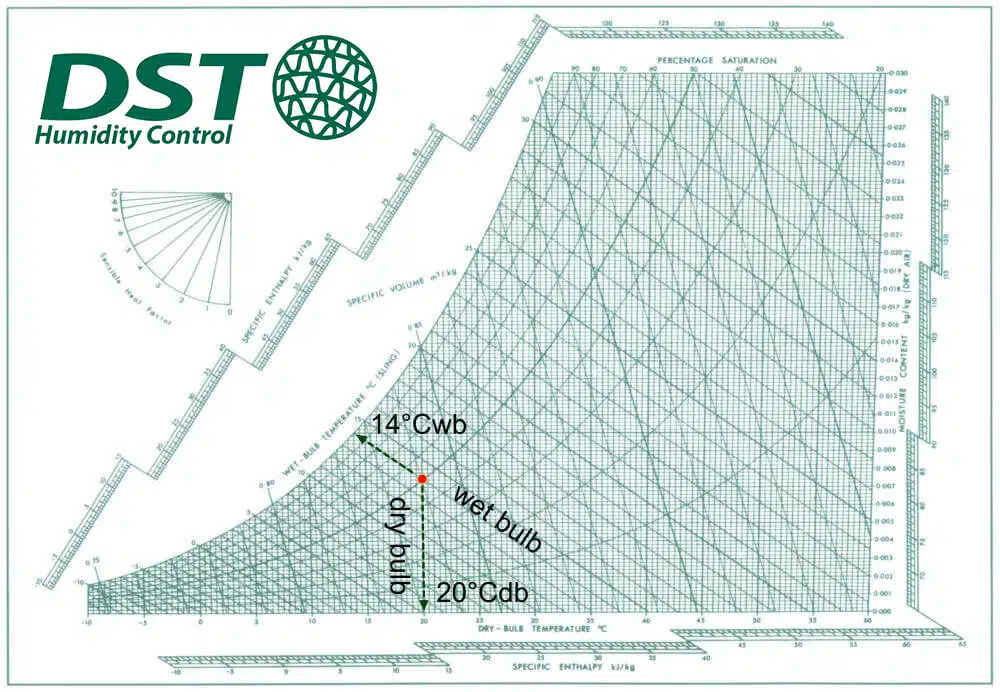
DST psychrometric chart marked 20 degrees dry bulb and 14 degrees wet bulb
  • Dry air

    About 78% nitrogen, 21% oxygen, 1% argon and carbon dioxide with traces. Water vapour is the part that varies. Dry air is a convenience for the calculation. Real air is moist air.

  • Dalton’s law

    The partial pressures of the gases add up to the total pressure. Water vapour has its own partial pressure in that sum.

  • A point on the chart

    Two known properties fix the others. The marked examples on this page use 20°C dry bulb and 50% RH unless the figure says otherwise.

Properties drawn on DST’s chart

Each figure is DST’s chart with one reading marked. The numbers are the ones printed on that figure.

DST psychrometric chart marked 20 degrees dry bulb and 14 degrees wet bulb

Dry bulb and wet bulb

Dry bulb is the ordinary air temperature, in °C. Wet bulb is the temperature of a thermometer with a wet wick. Evaporation cools the bulb, so drier air reads lower. At 100% RH the two are equal. The chart marks 20°C dry bulb and 14°C wet bulb.
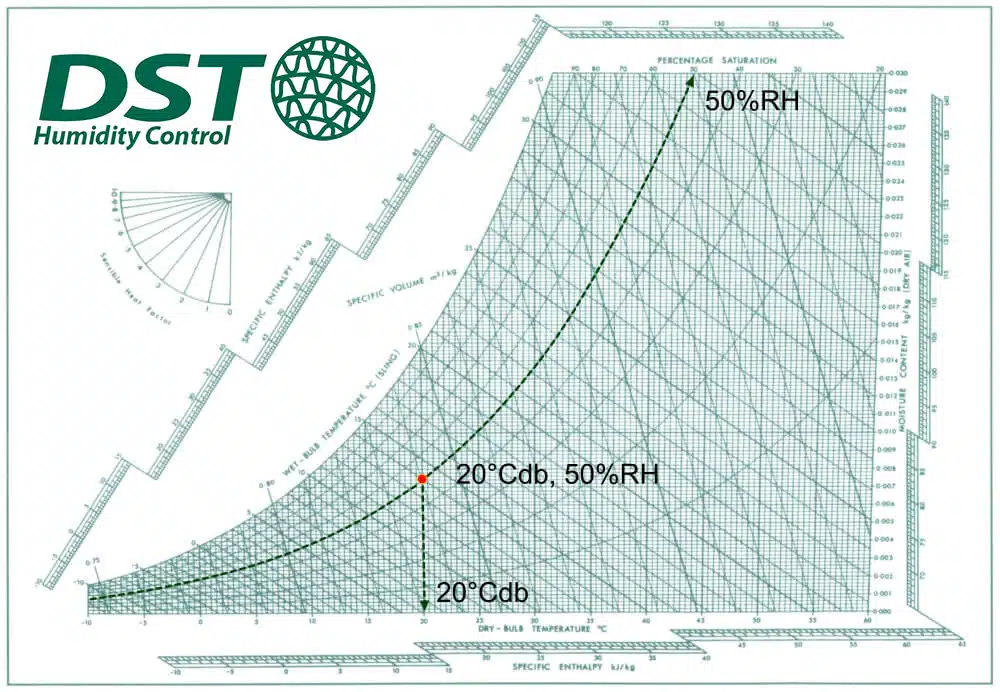
DST psychrometric chart with a 50 percent RH curve through a point marked 20 degrees dry bulb

Relative humidity

Relative humidity is 100% times the partial pressure of water vapour divided by the saturation pressure at that temperature. The chart draws it as curves of percentage saturation. The marked curve is 50% RH through 20°C dry bulb.

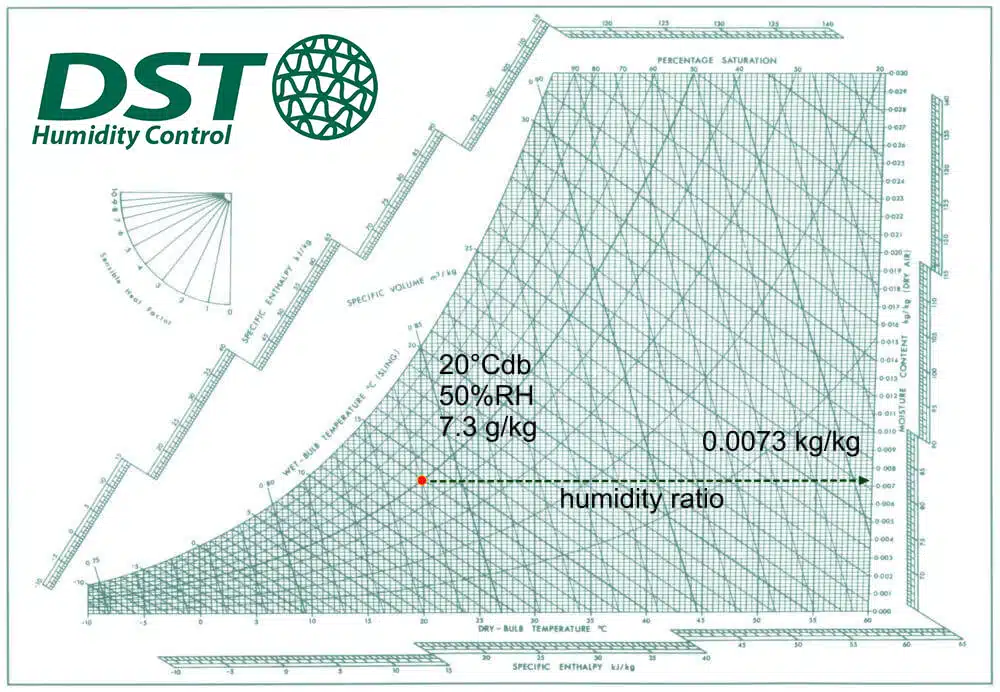
DST psychrometric chart marking humidity ratio 0.0073 kilograms per kilogram at 20 degrees and 50 percent RH

Humidity ratio

Humidity ratio, also called moisture content, is the mass of water mixed with 1 kg of dry air. It does not change when the air is heated or cooled, unless the air is cooled below its dew point. It is not the same as absolute humidity. The chart marks 0.0073 kg/kg, which is 7.3 g/kg, at 20°C and 50% RH.

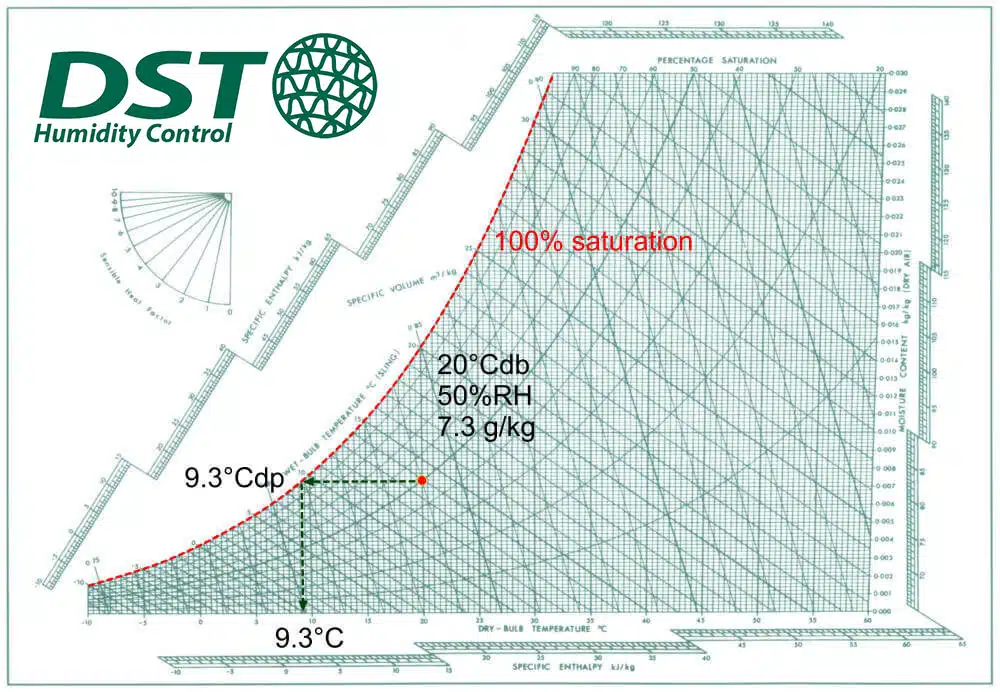
DST psychrometric chart marking 20 degrees, 50 percent RH, 7.3 grams per kilogram, and a dew point of 9.3 degrees

Dew point

Dew point is the temperature at which the air is saturated. Cool it further and moisture is deposited. It is always at or below the dry bulb. At ordinary atmospheric pressure it lies between −273°C and 100°C. Read it where the humidity ratio meets the 100% curve. The chart marks 9.3°C at 20°C, 50% RH and 7.3 g/kg.

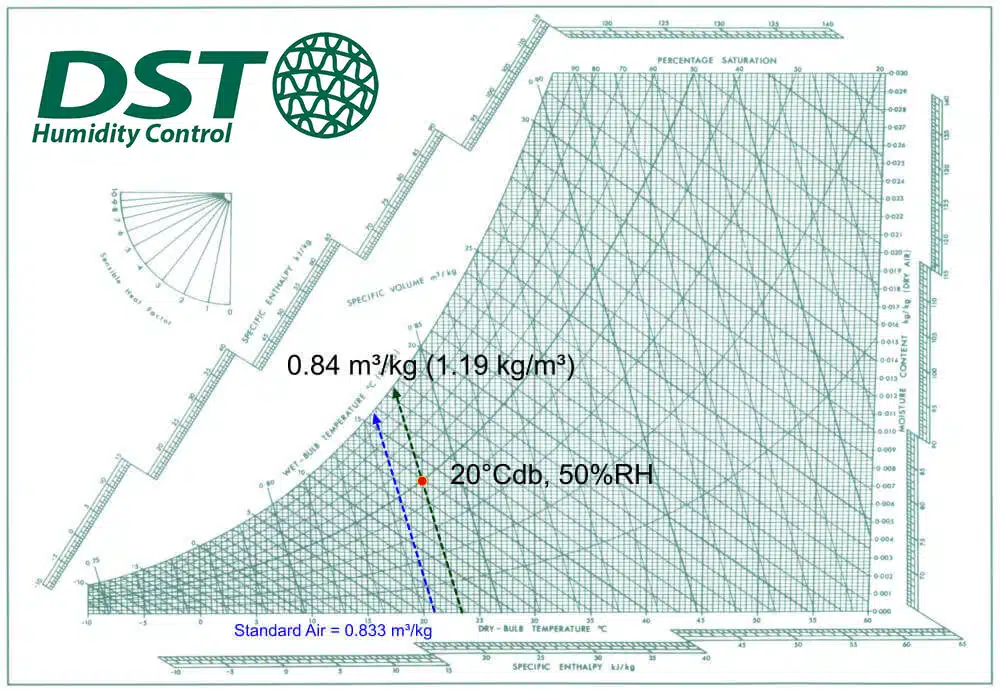
DST psychrometric chart marking 0.84 cubic metres per kilogram at 20 degrees and 50 percent RH, and standard air at 0.833

Specific volume

Specific volume is the volume of 1 kg of dry air, in m³/kg. It is the inverse of density. Water vapour does not change that volume, from Dalton’s law. The chart marks 0.84 m³/kg (1.19 kg/m³) at 20°C and 50% RH, and labels standard air at 0.833 m³/kg.

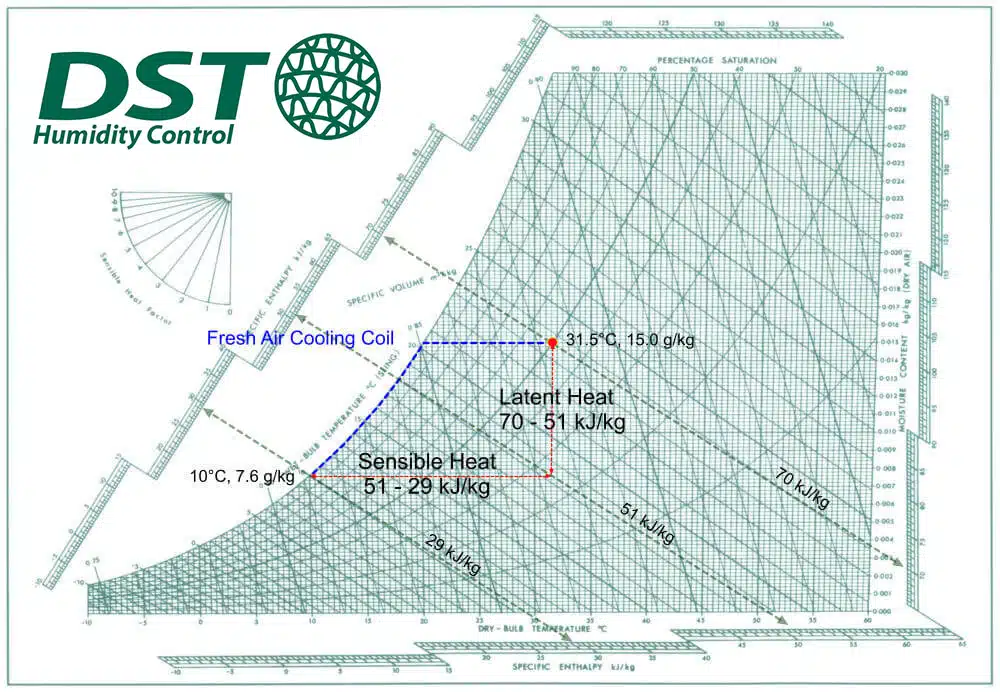
DST psychrometric chart of a cooling process from 31.5 degrees and 15 grams per kilogram to 10 degrees and 7.6 grams per kilogram

Sensible and latent heat

Sensible heat changes temperature only. Latent heat changes the state of the water, with no change in temperature. Both are in kJ/kg, and 1 kJ/s is 1 kW. The chart works an example from 31.5°C and 15.0 g/kg down to 10°C and 7.6 g/kg. Total heat 70 − 29 = 41 kJ/kg. Latent 70 − 51 = 19 kJ/kg. Sensible 51 − 29 = 22 kJ/kg.

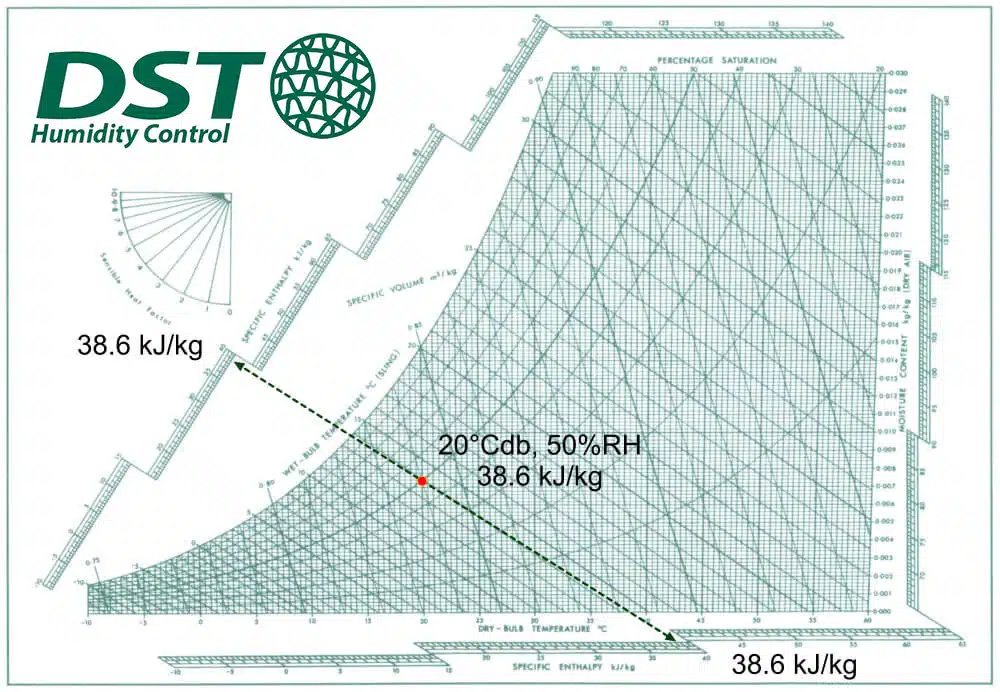
DST psychrometric chart marking 38.6 kilojoules per kilogram at 20 degrees and 50 percent RH

Specific enthalpy

Enthalpy of the moist air is the sensible heat plus the latent heat, in kJ/kg. The published zero is dry air at 0°C and 0% RH. Do not read the wet-bulb lines as enthalpy lines. The chart marks 38.6 kJ/kg at 20°C and 50% RH.

Terms that are not plotted as a scale

These are used in specifications and in product data. They are not a separate line on a standard psychrometric chart.

Hands on a laptop beneath an illustration of a psychrometric chart
  • Absolute humidity

    Grams of water in a cubic metre of moist air at a stated temperature and pressure. It is not the humidity ratio.

  • Specific humidity

    The mass of water vapour divided by the mass of dry air plus vapour. It is related to humidity ratio, and is rarely the number used.

  • Equilibrium moisture content

    The water in a material once it has settled, as a percentage of the material weight. The published example is 10% at 40% RH: 10 g of water in 100 g of material. The surrounding relative humidity is what sets it.

  • Equilibrium relative humidity

    The relative humidity at which a material neither gains nor loses moisture. In the published example, a material that should hold 10% moisture content has an ERH of 40%. Temperature can move both the moisture content and the ERH.

  • Water activity

    The availability of water in a product. Pure water is 1.00. The published definition treats water activity as one hundredth of the relative humidity, so 40% RH is written 0.40.

  • Standard air

    A reference density of 1.2 kg/m³, or a specific volume of 0.833 m³/kg, so a measured volume flow can be treated as a mass flow.

From the explanation to a unit

These notes describe the method. A sale or a hire is a separate conversation, matched to the site.

  1. I need help choosing

    Describe the space, the temperature and any humidity or dew point you already know.

    Ask about a duty
  2. Using the chart

    A shorter page on how two known values fix a point, without working through every term.

    Read the psychrometric chart page
  3. I would rather call

    Our office number is 01422 312 562, Monday to Friday, 8.30am to 5.00pm.

    Call 01422 312 562

Questions

Does humidity ratio change when the air is heated?

No. The mass of water per kilogram of dry air stays the same until the air is cooled below its dew point and moisture leaves it.

Are wet-bulb lines the same as enthalpy lines?

No. They lie close together, which is why the chart warns against reading one as the other.

Where do the example numbers come from?

They are the marks printed on DST’s psychrometric chart: 20°C and 50% RH, the 9.3°C dew point, and the cooling example from 31.5°C to 10°C.

Describe the condition you need

Temperature, the space, and any humidity or dew point you already know.

Or call 01422 312 562

Monday to Friday, 8.30am to 5.00pm