
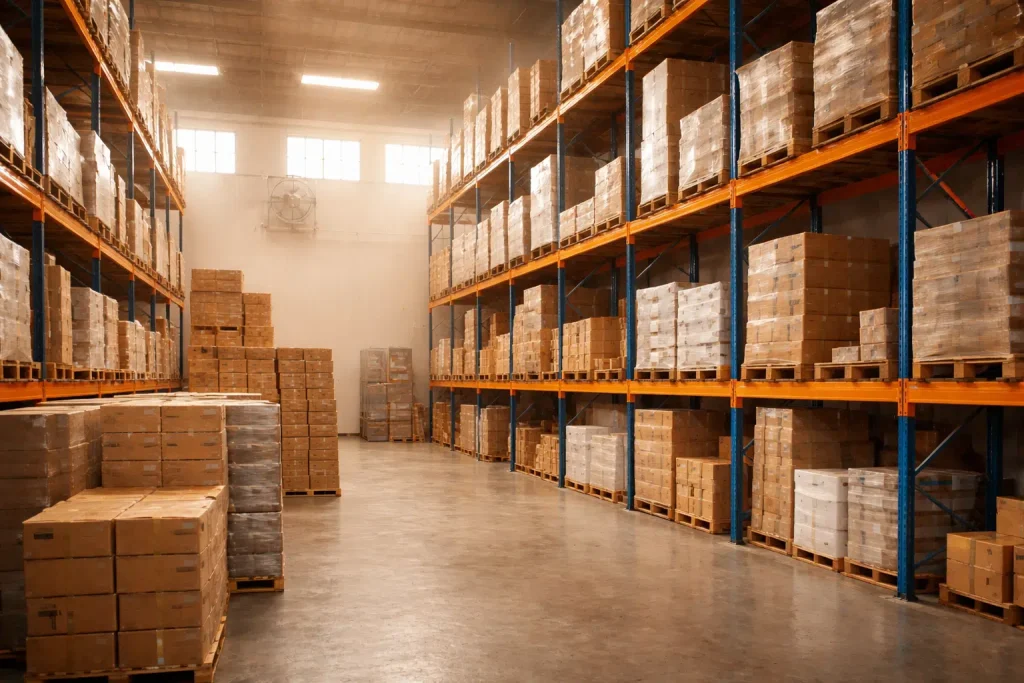
What moisture damages
Product quality, packaging strength, racking corrosion and mould on cold spots. Claims and scrap often start here.
Applications
Warehouse humidity rises and falls with doors, seasons and stock. Corrosion, mould, damp packaging and condensation on cold surfaces follow. Desiccant drying holds storage air steady when heating alone cannot.
Door traffic
Each opening brings outside moisture into the hall.
Stock and packaging
Cardboard softens. Metals rust. Hygroscopic goods take up vapour.
Building fabric
Cold roofs and walls run wet when internal dew point is too high.
Not just comfort
Humidity control protects goods and structure, not only how the hall feels.
Large volumes and busy doors make the moisture load continuous. The unit has to match that load at the temperature the warehouse actually runs.
Product quality, packaging strength, racking corrosion and mould on cold spots. Claims and scrap often start here.
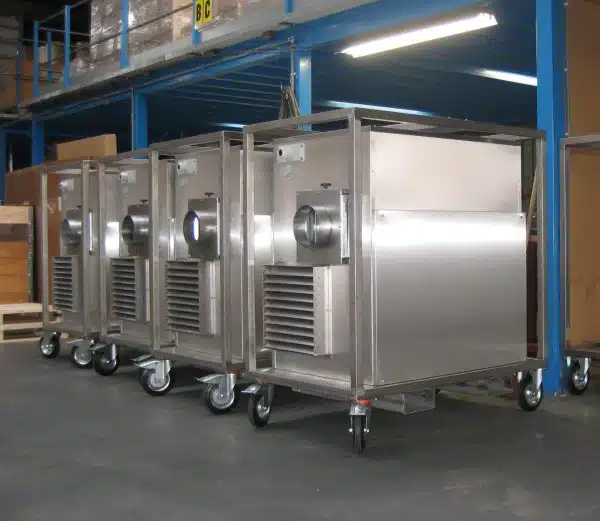
Stand-alone or ducted units recirculate warehouse air. Zoning around high-value stock is sometimes enough; sometimes the whole hall is treated.

Smaller sealed stores are covered on the dry storage page. The physics is the same at a different scale.
Read about dry storageThese notes describe the application. A sale or a hire is a separate conversation, matched to the site.
Describe the space, the temperature and any humidity or dew point you already know.
Get adviceSmaller sealed stores of moisture-sensitive goods.
Read about dry storageOur office number is 01422 312 562, Monday to Friday, 8.30am to 5.00pm.
Call 01422 312 562Heating changes relative humidity for a given moisture content. It does not remove vapour, and energy cost rises without resolving damp stock.
Not necessarily. High-value zones, packing areas or cold corners may be sufficient. Door pattern and stock type determine the scope.
Hall size, door openings, stock type, where damage appears, and any humidity already required by customers or by the goods.
Tell us about the space, the temperature, and any humidity or dew point you already know.
Or call 01422 312 562
Monday to Friday, 8.30am to 5.00pm