Skip to content

Technology

Installation examples

These are the published duct arrangements for stand-alone DST units. The room can be slightly above or below the pressure outside, and the wet reactivation air always has to leave the building. A ducted plant is a separate design.

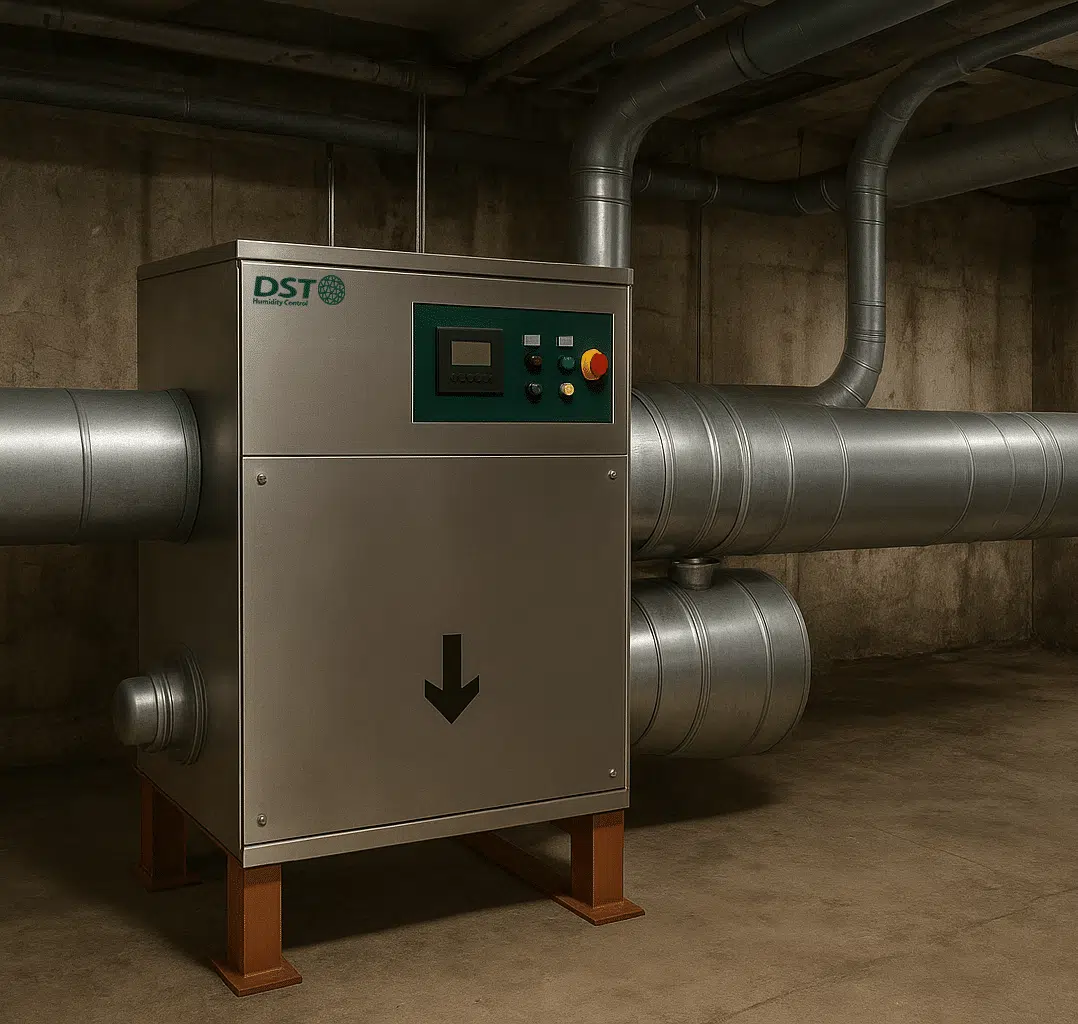
Stainless steel DST dehumidifier connected to large metal ducts
  • Closed rooms

    Process air is taken from the room and the dry air is returned to it.

  • Pressure

    A fresh-air connection holds the room slightly positive. Leaving the reactivation inlet unducted holds it slightly negative.

  • Open systems

    Dry air is blown into an object and is not returned. The published name is total loss.

  • Wet air

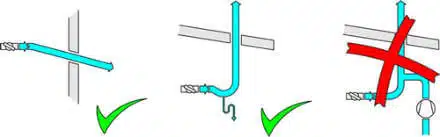
    The reactivation outlet has to fall to outside, or have a drain. A trapped low point is the arrangement the diagram crosses out.

Eight published arrangements

Systems 1 to 4 use Consorb or Recusorb with two air paths. Systems 5 and 6 are the Recusorb DR, which uses one fan. Systems 7 and 8 blow through an object instead of recirculating.

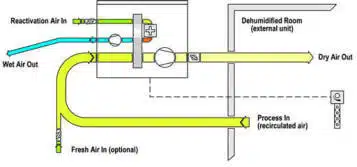
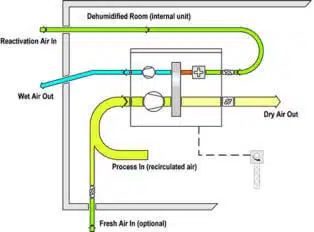
Duct diagram of a unit inside the room, with recirculated process air, optional fresh air, and wet air leaving the building

System 1. Consorb inside the room

A Consorb DC or CZ unit in the room, with process air recirculated. Add fresh air at the process inlet if the room should be under positive pressure. Omit the reactivation inlet duct if it should be under negative pressure.
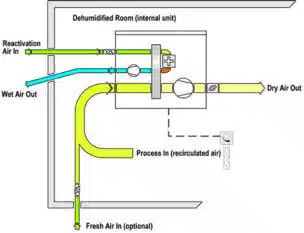
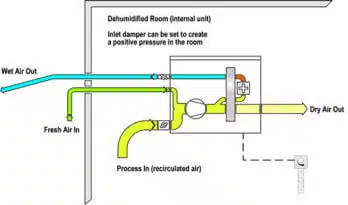
Duct diagram of an internal unit with recirculated process air, a dashed process inlet, and wet air out

System 2. Recusorb inside the room

The same placement with a Recusorb R or RZ. The unit recovers heat from the rotor into the incoming regeneration air. The fresh-air and pressure choices are the same as system 1.

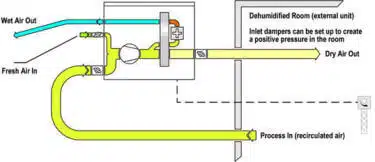
Duct diagram labelled dehumidified room, external unit, with recirculated process air and optional fresh air

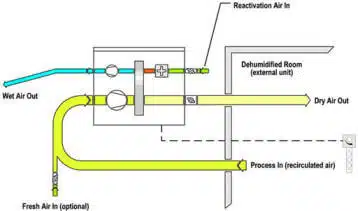
System 3. Consorb outside the room

A Consorb DC or CZ standing outside, still recirculating the room air. Optional fresh air for positive pressure.

Duct diagram of an external unit with recirculated process air and wet air ducted outside

System 4. Recusorb outside the room

A Recusorb R or RZ outside the room, with heat recovery, and the same choice of positive or negative pressure.

Duct diagram of an internal unit with an inlet damper, fresh air, and wet air out

System 5. Recusorb DR inside

The DR stands inside the boundary walls. An inlet damper can admit fresh air for positive pressure. Leave that fresh-air duct off for negative pressure.

Duct diagram of an external unit with inlet dampers, fresh air, and recirculated process air

System 6. Recusorb DR outside

The DR stands outside the walls. Inlet dampers are used to hold either positive or negative pressure.

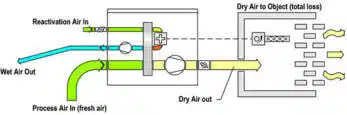
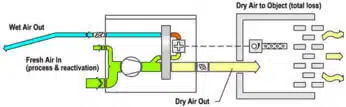
Duct diagram with process air from fresh air and dry air marked to an object, total loss

System 7. Recusorb, total loss

A Recusorb R or RZ blowing into or through an object. The dry air is not returned. Process air is fresh air, and the wet air still leaves outside.

Duct diagram for dry air blown into an object, marked as an open total-loss arrangement

System 8. Recusorb DR, total loss

The same open arrangement with a Recusorb DR, which uses a single fan for both airstreams.

Three wet-air duct sketches: two marked correct, and a trapped low point crossed out

Wet-air outlet

This applies to every desiccant installation above. The drawing marks two outlets as acceptable: a duct that falls continuously out through the wall, and a duct that rises with a drain at the bottom. It crosses out a duct that dips and then rises, because water collects in the low point and blocks the airflow.

From the explanation to a unit

These notes describe the method. A sale or a hire is a separate conversation, matched to the site.

  1. I need help choosing

    Describe the space, the temperature and any humidity or dew point you already know.

    Ask about a duty
  2. Which airflow the unit uses

    Consorb, Aquasorb, Recusorb and Recusorb DR, before the ducts are drawn.

    Read the desiccant principles
  3. I would rather call

    Our office number is 01422 312 562, Monday to Friday, 8.30am to 5.00pm.

    Call 01422 312 562

Questions

Can the wet air discharge indoors?

No. The wet reactivation air is the moisture that has been removed. It has to leave the building, and the duct has to be arranged so condensate does not run back.

How is the room held at a slight pressure?

Positive pressure uses a fresh-air inlet. Negative pressure, on the two-fan units, means leaving the reactivation inlet open to the room so the unit draws from the room and exhausts outside.

Are these the only layouts?

They are the published stand-alone examples. A larger ducted system, or a unit built into other plant, is drawn for that site.

Describe the condition you need

Temperature, the space, and any humidity or dew point you already know.

Or call 01422 312 562

Monday to Friday, 8.30am to 5.00pm