
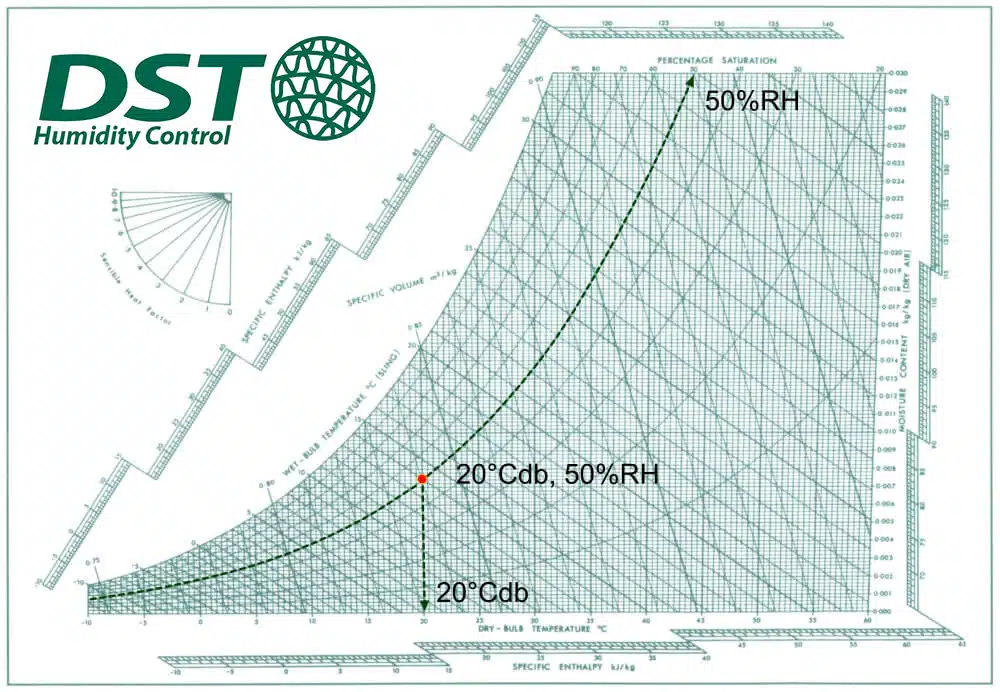
Relative humidity
Air at 20°C and 50% relative humidity holds half the water vapour it would hold if it were saturated at 20°C. At 100% it is saturated. Cool it further and water comes out on cold surfaces.
Technology
Dehumidification takes water vapour out of the air. Heating a room changes how that moisture behaves. It does not remove it. The choice is then how the water leaves: condensed on a cold coil, or collected on a desiccant rotor and exhausted outside.
Relative humidity
The water vapour in the air, compared with the most that air can hold at the same temperature.
Dew point
The temperature at which that air would be saturated and start to leave water on a cold surface.
Two methods
A cooling coil condenses moisture. A desiccant rotor adsorbs it and a heated airstream drives it off.
What sets the duty
The moisture coming in, the condition to be held, the airflow, and how the room is used.
The same air can be warm and wet, cool and dry, or somewhere between. The useful numbers are temperature, relative humidity, and dew point, read together.
Air at 20°C and 50% relative humidity holds half the water vapour it would hold if it were saturated at 20°C. At 100% it is saturated. Cool it further and water comes out on cold surfaces.
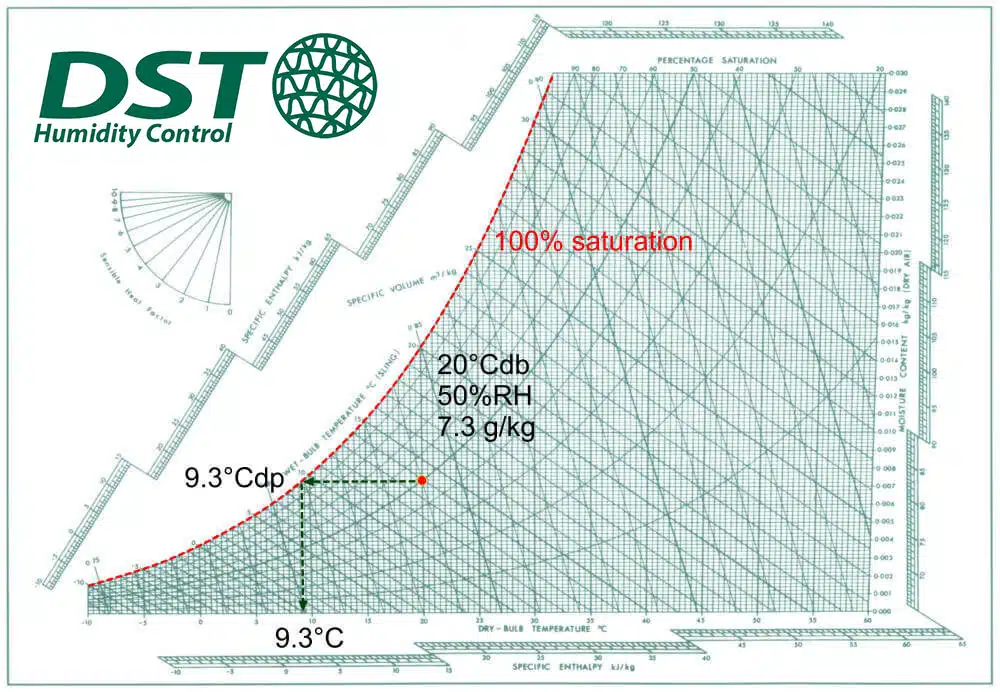
Dew point is the temperature that air must be cooled to before water starts to leave it. A surface stays dry while its temperature is above the dew point of the air touching it. On DST’s chart, air at 20°C and 50% RH is marked at 7.3 g/kg and a dew point of 9.3°C.
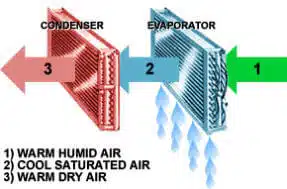
Air passes a cold coil, water condenses, and the air is usually warmed again by the condenser. That suits warm, humid rooms. The lower the dew point you need, the colder the coil has to run, until frost on the coil becomes the limit.
Cooling or desiccant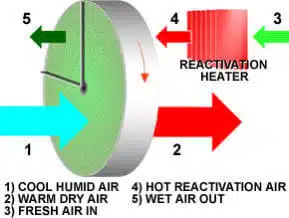
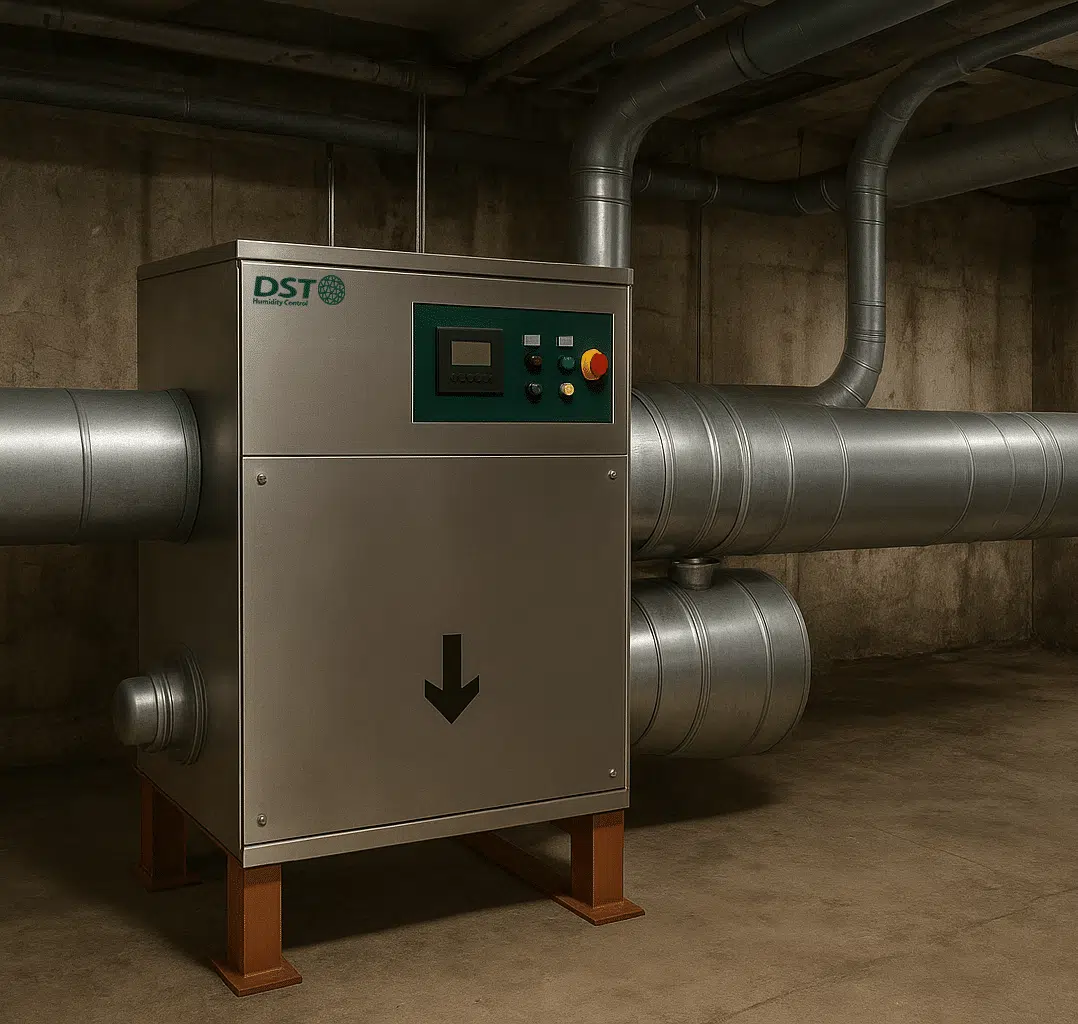
Process air passes through a rotor and leaves drier, and warmer. A second airstream is heated, drives the moisture off the rotor, and is ducted outside. This is the method used when the dew point, or the room temperature, is outside what a cooling coil can hold.
How a desiccant unit worksA unit is sized from the moisture that has to be removed, not from the floor area alone.
Ventilation, doors, the process, and moisture already in the building fabric.
A relative humidity, a dew point, or both, at a stated temperature.
Whether the unit stands in the room or on ducts, and whether the room should run slightly above or below the pressure outside.
Food and pharmaceutical production, electronics and battery dry rooms, museums, warehouses, water treatment, sports halls, bridges, and cold stores. Each has a different moisture source and a different target.
These notes describe the method. A sale or a hire is a separate conversation, matched to the site.
Describe the space, the temperature and any humidity or dew point you already know.
Ask about a dutyCondensation, ice, corrosion, mould and product drying, with the thresholds DST publishes for each.
Read why humidity is controlledOur office number is 01422 312 562, Monday to Friday, 8.30am to 5.00pm.
Call 01422 312 562Heating raises the temperature, so the same amount of water vapour is a lower relative humidity. The water is still in the room unless something removes it.
In warm, humid air, where the coil can condense moisture and still stay above the point where it frosts. Lower dew points, and cold rooms, are where a desiccant rotor is used.
The temperature, the humidity or dew point to hold, the moisture coming in, and whether the unit can sit in the room or has to be ducted.
Temperature, the space, and any humidity or dew point you already know.
Or call 01422 312 562
Monday to Friday, 8.30am to 5.00pm