
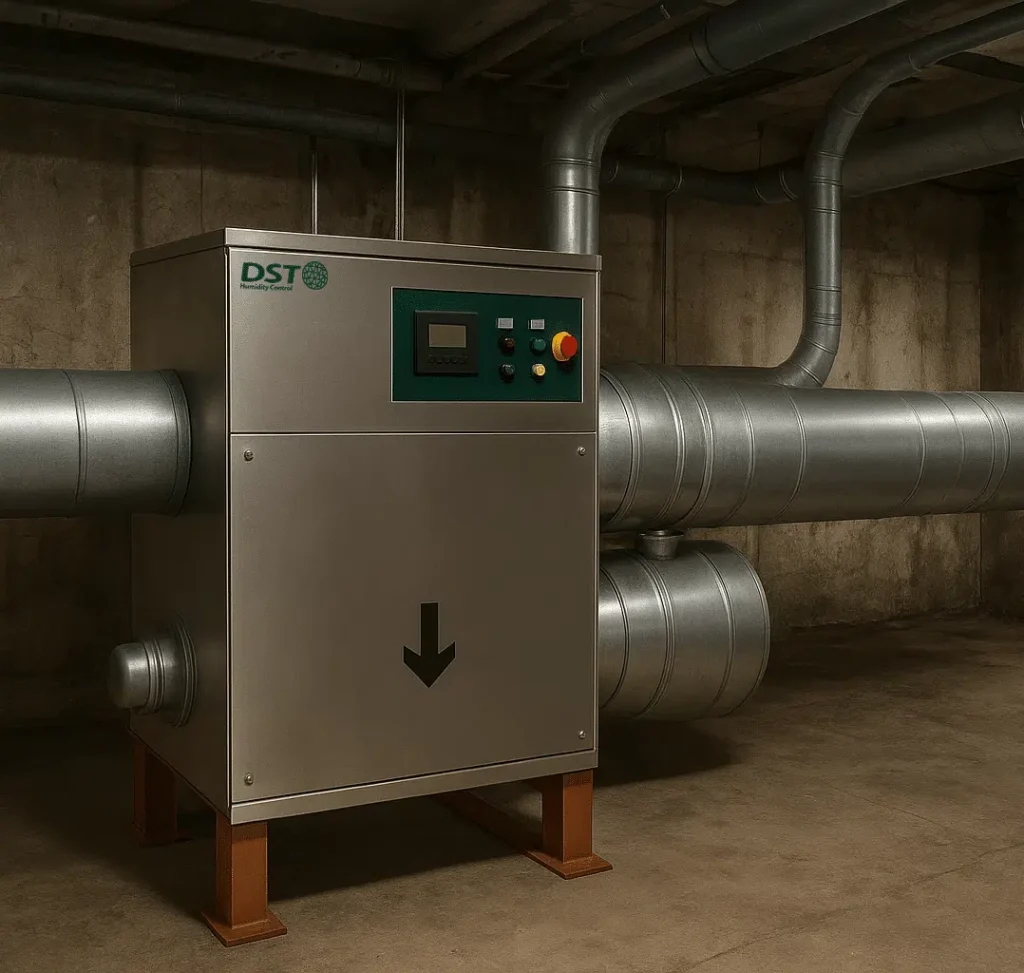
Dehumidification
A cooling coil or a desiccant rotor, chosen from the dew point and the room temperature. The two methods are set out on their own page.
Read about dehumidificationTechnology
Humidity control holds the moisture in the air inside a stated range. Sometimes that means removing water. Sometimes it means adding it. The reading that matters depends on whether the process cares about relative humidity or about the actual mass of water in the air.

Relative humidity
Changes with temperature even when the mass of water in the air stays the same.
Absolute humidity
The mass of water in a volume of air. It does not change just because the room is heated.
High humidity
Condensation, corrosion, mould, and materials that take up moisture.
Low humidity
Static, drying out, cracking, and dimensional change in materials that give water up.
Most duties are a mix of removing moisture, adding it, and controlling the air that is allowed in.
A cooling coil or a desiccant rotor, chosen from the dew point and the room temperature. The two methods are set out on their own page.
Read about dehumidification
Steam, ultrasonic mist, wetted pads, or a spray, used where the air would otherwise be too dry for the material or the process.

Outdoor air brings its own moisture in. A humidity target has to include that air, the leakage of the building, and whatever heating or cooling is already happening.
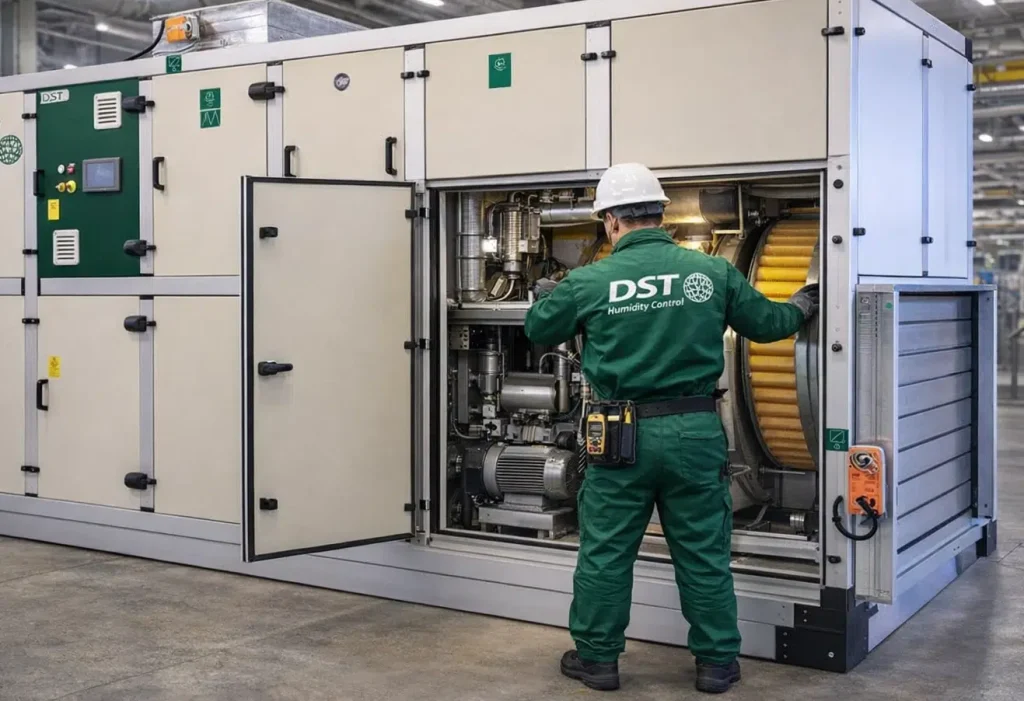
A duty is supervised with a hygrometer. Capacitive sensors and chilled-mirror instruments are the types commonly described for this work. A building management system can read the same point and switch the plant.
The target is set by the material or the process, not by a single number that suits every room.

Tablets, coating and capsules are quoted against relative humidity because the moisture affects flow, sticking and the finished product. Written procedures usually name the range.
High humidity changes how components behave and raises failure rates. Very dry air is the other limit, because of static.
Packaging, powders, timber, and hygroscopic ingredients change dimension or condition as the air changes. The design starts from the latent load, the sensible load, and the outdoor air.
These notes describe the method. A sale or a hire is a separate conversation, matched to the site.
Describe the space, the temperature and any humidity or dew point you already know.
Ask about a dutyOnce the duty is known, the unit is chosen from the DST range rather than from a catalogue size.
Go to dehumidifier salesOur office number is 01422 312 562, Monday to Friday, 8.30am to 5.00pm.
Call 01422 312 562No. Relative humidity is a comparison with saturation at that temperature. Heat the air and the relative humidity falls even though the water is still there.
When the air is dry enough to cause static, cracking or a change in dimensions. Steam, ultrasonic mist, pads and sprays are the usual methods.
The moisture and heat loads, including outdoor air, and the condition the room has to hold. The unit follows from those figures.
Temperature, the space, and any humidity or dew point you already know.
Or call 01422 312 562
Monday to Friday, 8.30am to 5.00pm