
Skip to content

Technology

Cooling or a desiccant rotor

Both methods remove water vapour. A cooling unit condenses it on a cold coil. A desiccant unit holds it on a rotor and drives it off with hot air. They are often used together when the air has to be both cool and very dry.

Two people in green workwear and hard hats looking at a plant display
  • Cooling

    Effective in warm, humid air. Output depends on how far the dry bulb sits above the dew point.

  • A practical coil limit

    Even with a coil at 0°C, the air leaving is unlikely to be much below 10°C dew point.

  • Desiccant

    The dry air is warmer than the inlet, because adsorption releases heat. Heater power sets how dry it gets.

  • Together

    DST publishes air as dry as −60°C dew point when a desiccant stage follows pre-cooling.

How each method moves the air

The diagrams are the published principle drawings. The notes follow those drawings.

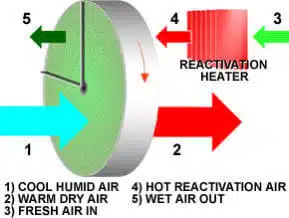
Diagram of a rotor, a reactivation heater, cool humid air in, warm dry air out, and wet air exhausted

Desiccant rotor

The rotor is a matrix of channels. It is divided into a process sector and a reactivation sector, typically about three quarters and one quarter, with seals between them. It turns at about 8 to 12 revolutions an hour. Cool humid air leaves warm and dry. Heated reactivation air, usually fresh air, leaves warm and wet and is exhausted outside. A heat-recovery sector, on Recusorb, preheats that reactivation air, which reduces heater power and leaves the dry air cooler and drier.

Desiccant principles
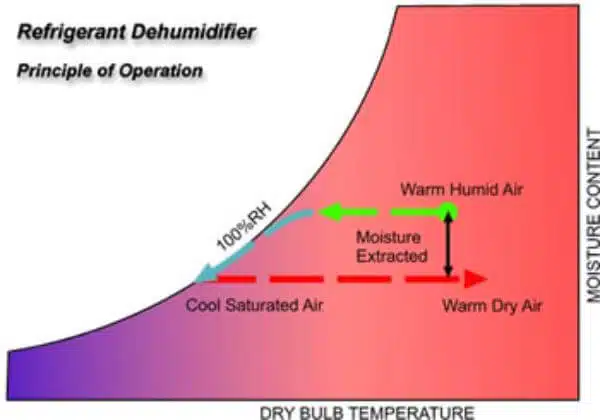
Psychrometric diagram titled refrigerant dehumidifier, showing warm humid air cooled to saturation and then warmed as dry air

Refrigerant dehumidifier

Warm humid air is cooled to saturation and moisture is extracted. The air then crosses the condenser, so it leaves warmer and drier. Condensate goes to a tray or a drain. Air that is already at 20°C and 50% RH has a dew point below 10°C. If the required dew point is lower still, the coil runs below freezing, frosts, and a defrost cycle stops the dehumidifying.

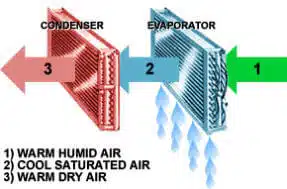
Diagram of air passing an evaporator, where condensate drips off, then a condenser

The coil path

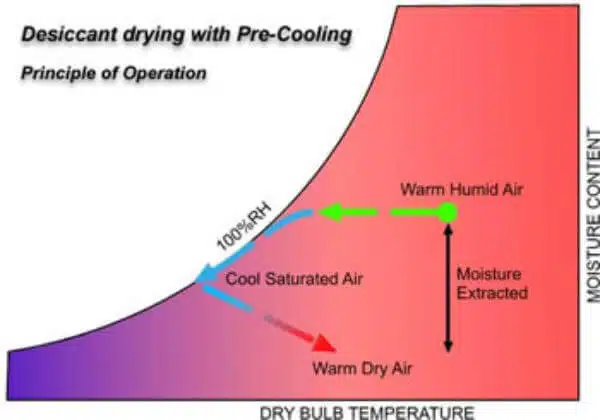
Air enters warm and humid, leaves the evaporator cool and saturated, then leaves the condenser warm and dry. That is the whole cooling cycle drawn as hardware.

Psychrometric diagram titled desiccant drying with pre-cooling, from warm humid air to cool saturated air then to warm dry air

Pre-cooling, then the rotor

A chilled-water coil can take air safely to about 10°C dew point. A colder latent coil can go a little further, but ice on the fins becomes a barrier and chokes the airflow. For fresh air that has to finish below that dew point, cool only to about 10°C dew point and let the rotor take the rest. The chart shows warm humid air, then cool saturated air, then warm dry air.

Diagram of a cooling coil followed by a desiccant rotor and a reactivation heater

The combined plant

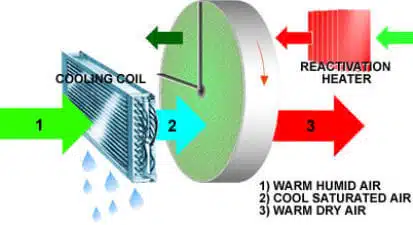
The hardware is a cooling coil, then the rotor and its reactivation heater. In warm humid weather the coil does the first part of the drying. In cold weather the rotor can run alone. Adsorption puts heat into the dry air, so a second coil after the rotor is for temperature only: it has no latent duty. DST’s published figure for this arrangement is air as dry as −60°C dew point.

From the explanation to a unit

These notes describe the method. A sale or a hire is a separate conversation, matched to the site.

  1. I need help choosing

    Describe the space, the temperature and any humidity or dew point you already know.

    Ask about a duty
  2. Duct arrangements

    How a stand-alone unit is connected once the method has been chosen.

    See installation examples
  3. I would rather call

    Our office number is 01422 312 562, Monday to Friday, 8.30am to 5.00pm.

    Call 01422 312 562

Questions

Why not just run the coil colder?

Below freezing the coil frosts. Defrost, often with hot gas, interrupts the drying, and ice on the fins blocks the air.

Why is the dry air from a rotor warm?

Adsorption releases heat into the process air. A cooling coil after the rotor can take that heat out without having to condense more water.

Where does the −60°C figure come from?

It is DST’s published dew point for very dry air from a combined cooling and desiccant arrangement, not a condition every unit produces.

Describe the condition you need

Temperature, the space, and any humidity or dew point you already know.

Or call 01422 312 562

Monday to Friday, 8.30am to 5.00pm