
Condensation
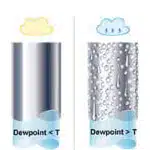
If the dew point is below the surface temperature, the surface stays dry. If it is above, water forms. That water affects safety, electrical equipment, product quality, packaging and handling.
Technology
Moisture causes different problems at different temperatures. The notes below are the published ones: condensation and ice follow dew point, and the relative-humidity figures are the levels DST gives for corrosion, odour, mould and bacteria. They are guidance for a design, not a promise about a particular room.

Condensation and ice
A surface stays dry when the dew point of the air is below the surface temperature.
Corrosion
DST’s note says the rate on iron and steel is dramatically reduced below 50% RH, and describes it as eliminated at 40% RH.
Mould
DST’s note says mould and fungus are prevented below 70% RH.
Odour and bacteria
DST’s note places odour reduction, and an unsuitable environment for many bacteria, below 50% RH.
Each drawing is the one published with that note. The percentages are the ones printed on the drawing or in the accompanying text.
If the dew point is below the surface temperature, the surface stays dry. If it is above, water forms. That water affects safety, electrical equipment, product quality, packaging and handling.
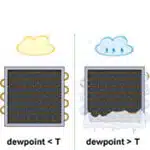
The same dew-point test, on a surface below freezing. In a cold store the published consequences are damaged packaging, unsafe floors, and coils that freeze and lose output. A lower dew point from a desiccant unit reduces the ice and frost.
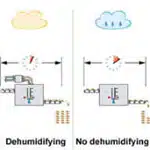
A low relative humidity shortens drying when the product cannot take much heat. On a cooling product, dry air avoids condensate and the product cools faster.
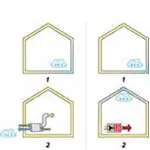
Heat alone moves moisture around the building. Heat plus outdoor air uses a lot of energy and brings more moisture in when the weather is humid. A dehumidifier takes water out of the building.
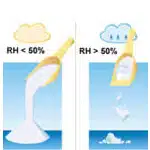
Powders, dried food, confectionery and pharmaceuticals take up water. The drawing compares a powder below and above 50% RH. Many of these duties need dew points that only a desiccant unit reaches.
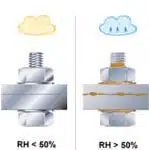
The drawing shows steel clean below 50% RH and corroded above it. DST’s text says the rate on iron and steel is dramatically reduced below 50% RH and describes corrosion as eliminated at 40% RH. The same note lists bridges, power stations, ships in refit or lay-up, offshore structures, aircraft and military vehicles, and says drying is often more effective and cheaper than coatings alone.
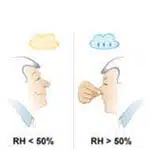
DST’s note says odours are reduced below 50% RH, and gives sewage stations as an example.
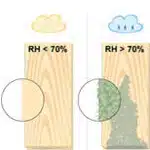
The drawing shows a clean surface below 70% RH and growth above it. DST’s note says mould and fungus are prevented below 70% RH.
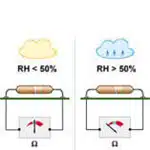
The drawing compares a component below and above 50% RH. High humidity changes electrical characteristics and raises failure rates.
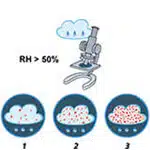
Bacteria need moisture. DST’s note says that holding the surrounding air below 50% RH removes a suitable environment for many types. The drawing itself only marks the side above 50% RH.
These notes describe the method. A sale or a hire is a separate conversation, matched to the site.
Describe the space, the temperature and any humidity or dew point you already know.
Ask about a dutyCooling coil, desiccant rotor, or both, once the problem is known.
Cooling or desiccantOur office number is 01422 312 562, Monday to Friday, 8.30am to 5.00pm.
Call 01422 312 562They are the levels in DST’s published notes for corrosion, odour, bacteria and mould. A room still has to be designed for its own temperature, surfaces and moisture load.
Heat changes the relative humidity but leaves the water in the building. Outdoor ventilation can bring more water in. A dehumidifier removes it.
No. Warm, humid air and ordinary condensation are often a cooling duty. Desiccant units are used for lower dew points and for cold rooms where a coil would ice.
Temperature, the space, and any humidity or dew point you already know.
Or call 01422 312 562
Monday to Friday, 8.30am to 5.00pm